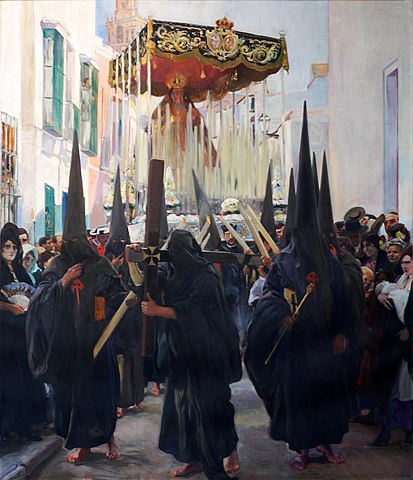
Holy Week is celebrated every year between the months of March and April, for seven days, from Palm Sunday to Easter Sunday. Its vespers are on Good Friday of Dolores and Saturday of Passion.
Holy Week in Seville has existed since the Middle Ages, although it was not until the 16th century when the brotherhoods were consolidated. This great event is held to commemorate the Passion of Christ. The first Holy Week in Seville was established by the Marquis of Tarifa. D. Fabrique Enriquez de Ribera, in 1521, on the first Friday of March. It all began with the return to Seville from Jerusalem.
The Marquis started a Way of the Cross from his estate, which would end at 997 meters, which is the distance that Jesus travelled from the Praetorium of Pilate (which is why the house where the Marquis lived is called Casa Pilatos) to Golgotha (the place of his death). And that, in Seville, this distance would culminate at the cross in the countryside.
The worship of the brotherhoods
There are three worship services, the main one is external, and is the processional procession, the other two services are internal throughout the year.
These services take the form of novenas, septenaries, quinarios, triduos and besamanos.
Processional processions
Sixty brotherhoods celebrate between Palm Sunday and Easter Sunday, while eleven of them process on vespers, which are Friday of Sorrows and Saturday of Passion.
Holy Week has a special day, Holy Thursday, “La Madruga”. On this day the most popular brotherhoods of Seville go out in procession. They make their way through the night, until they are collected in the morning.
The other group of brotherhoods make their penitential procession to the Santa Iglesia Catedral de Santa María la sede y de la Asunción in Seville. All the brotherhoods process their images of virgins and Christs from their churches to the cathedral. This route is called “la Carrera official”. This official procession begins in the Plaza de la Campana, where the council box is located, presided over by its president, and where the brotherhoods request the permission to make their route.
All the brotherhoods request this permission, except the Brotherhood of Silence, which requests it in writing. Once they have received the permission, they continue their route along Sierpes Street, continuing along the Plaza de San Francisco, along the Avenida de la Constitución and ending the official procession at the San Miguel door of the Cathedral, which they leave through the Puerta de Palos.
The processions open the way with the guide cross, which is usually accompanied by two Nazarenes carrying lanterns of incense.
This is a fundamental characteristic of Holy Week in Seville.
Behind the guide cross are the Nazarenes, who carry candles and crosses as penitence. The Nazarenes go in sections and by insignia, such as: the senatus, in memory of the Roman army that guarded Christ until his death. The simpecado in defence of the dogma of Our Lady of the Immaculate Conception. The flags with the liturgical colours, the standard and the rule book.
Band of music
Following the Nazarenes is the band of music. Music is another fundamental part of the Semana Santa. The band is made up of cornets, trumpets, clarinets, drums, trombones, and saxophone. Although not all brotherhoods are accompanied by a brass band.
Religious images
The images of the virgins and Christs are called Tallas (carvings). These works of art are made by master sculptors. The carvings are made of polychrome wood, which achieve a striking realism. This Gothic and Romanesque art was born between the 12th and 15th centuries, until the Renaissance period.
After the Council of Trent in 1545-1563, the church decided, in response to the Lutheran reform, to promote the plastic arts as a means of attracting the attention of the Christian faithful. This was the Baroque period when the art of imagery developed exponentially.
The pasos
The gold and silver work that adorns the pasos and insignia is another aspect worth highlighting. The gold and silver work that adorns the pasos and insignia occupies an outstanding place. There are numerous workshops in the city dedicated to this activity, and they are goldsmith artisans (master craftsmen), who oversee creating the moving works of art that we call pasos.
Another protagonist role is played by the embroidery of the Virgin’s mantles and the backdrops of the pasos de palio. A work of art in movement.
The costaleros
Costaleros are the men who carry the pasos.
They are called Costalero, because of the costal. The costal is a burlap padding that is placed on the head to support the weight of the paso, which is around 40 kilos that rest on the costaleros neck. A lumbar support or girdle is also worn to protect the lower back. The costaleros, usually go in a group of 30 to 36 in the small pasos and up to 54 costaleros in the large pasos.
Trabajaderas
The costaleros are positioned under the “trabajaderas”, in formations of five or six costaleros on each pole. These positions are called: costeros, corrientes and fijadores. Costeros or pateros, are the ones in the first and the last sidewalk. They are called costeros or pateros because they are placed next to the legs or stilts of the paso.
Corrientes, they are called the costaleros in the centre.
Fijadores, are the ones who go between the costeros and the corrientes.
The igualá
The igualá is the name given to the call made by the foreman to the costaleros. The foreman distributes the costaleros according to their height, to distribute the passage of the paso in a proportional way.
Foreman
The foreman is the person who directs the costaleros and has the great responsibility of leading the paso through the streets of Seville, without them suffering any type of damage or mishap.
Chicotá
Chicotá is the name given to the route that the costaleros cover in each time, from the moment they raise the paso to the moment they lower it. In Seville, there are many difficult areas and streets, with turns that make it very difficult to pass with the paso. This means an enormous effort on the part of the bearers and the foreman.
One aspect that literally makes one’s hair stand on end is precisely this, when the foreman gives the order, and the spokesperson transmits it to the other costaleros. His message is usually very emotional, to the point of making you cry when you hear it.
You can feel the passion, the suffering, and the immense love that they all share for their brotherhood.
Levantá
This is the moment when the foreman sounds the “llamador”, to warn the costaleros of the “levantá” (raising) of the paso. And the foreman usually dedicates it to someone.
Now of the raising, there is absolute silence, in such a way that the weight of the paso can be heard falling on the shoulders of the costaleros.
Saeta
The saeta is an a cappella song sung by one person dedicated to the Lord or the Virgin. It is common for these people to sing the saeta on a balcony or on the ground. And it is usually sung when the procession stops for the bearers to rest.
The saeta is a popular religious song without accompaniment, which has its origins in Andalusian folklore. It is generally sung by seguirilla or to the beat by martinete and its interpretation requires a very deep knowledge of cante jondo, typical of the flamenco musical tradition.
Nazarenes
The Nazarenes are the brothers and sisters of the brotherhood who make the penitential station with the clothing that appears according to the rules of their brotherhood. Each brotherhood has a different costume, in terms of tunic and footwear. The religious colours and insignia also vary. The nazarenos usually carry a hood, tunic, candles, candles, badges, lanterns, and crosses.
The Nazarenes are also organised in sections. In the first section in front of the paso are the ceroferarios acolytes, who are the ones who carry the candlesticks. The turiferarios acolytes are the ones who carry the incendiaries. Pertiguero, they carry a silver pole on their hands, and are responsible for the secularity of the acolytes (ordering the Nazarenes).
Altar boys are those who wear a garment called alba (white). In the past, the Nazarenes were only boys and men, but nowadays women and girls are also part of the Nazarenes.
Typical gastronomy
During Lent, it is traditional to eat certain foods that are the star dishes at this time of year. Specifically in the kitchens there is an abundance of cod in all its variants, Lenten stews, spinach with chickpeas, torrija and pestiños (honey-coated fritters).
Mantillas
The Mantilla in Holy Week
The mantilla is a very popular and traditional garment in Seville for religious ceremonies since the 19th century, made fashionable by Queen Isabel II for the noble classes of the time. Nowadays it is only worn during Holy Week, bullfighting, and weddings.
Although there is no evidence to prove it, it is said to have originated with the Iberians.
The use of this garment is a sign of mourning and a commemoration of the passion and death of Christ.
During Holy Week in Seville, on Holy Thursday and Good Friday mornings, many women over the age of 18 go out dressed in mantillas, with black combs and gloves, completely in mourning and holding a rosary in their hands and begin their journey through the thirteen churches that will go out in procession through the city in the early hours of the same day, in the case of Holy Thursday.
This traditional dress requires respect and knowledge to be correctly dressed, as it is not a costume.
How to wear a mantilla correctly
Type of mantilla: tradition dictates that women wear a lace mantilla on the night of Holy Thursday, although they also wear a chantilly mantilla. But there are several types of mantillas, Rectangular, veil of towel, rondeña, empanadilla, madroñera, being these more typical in Ronda. The types of lace are also different, bobbin or needle lace, although the most popular and recommended are lace and chantilly lace, there are hand and machine embroidered ones. It is important to wear the mantilla correctly and to do so, the hair must be properly tied up in a low bun. The comb, hairpins and brooch are then attached. It is important that the comb is sized according to the height of the woman wearing it.
The dress should be black, not too tight to the body and without neckline, with long or French sleeves and below the knee.
The accessories should be discreet, consisting of black crystal stockings, black shoes with medium heels, black gloves up to the wrist, black or tortoiseshell clutch type bag, silver, white gold or shiny earrings and silver brooch brocade and shiny brooches. Make-up should be soft, with light tones.
The Mantilla in the Bullring
On the Sunday before the fair, the traditional exhibition of carriage driving is held in the bullring of the Real Maestranza de Caballería in Seville, organised by the Real Club de Enganches de Andalucía.
This is a very important show worldwide due to the quality of the carriages that take part in this exhibition. Its spectacle of carriages pulled by imposing racehorses carrying women dressed in mantillas, makes it a fundamental part of this exhibition of great beauty, which is judged by a jury. The mantilla has to be of a light colour (off-white, beige or champagne) and the dress of a cheerful colour below the knee, not too low-cut and of a plain colour so that it stands out with the light colour of the mantilla. The accessories are coral or pearl earrings and necklace, tortoiseshell comb, old silver brooch with rhinestones, small handbag, crystal and leather-coloured stockings, ballroom shoes, fan and manila shawl.
ILLUSTRIOUS SCULPTORS, ASSEMBLERS, AND IMAGE-MAKERS OF SEVILLE
Imagery, the sculptural speciality centred on the plastic representation of religious themes, has always been an art form that has been highly valued and understood throughout the history of our city. Always linked to Holy Week, the greatest authors, from Martínez Montañés to Antonio Castillo Lastrucci, have contributed their art to enrich Seville’s great spring celebration.
Thank you all for making Holy Week in Seville possible.
Image Painting: LOS NAZARENOS SEVILLA 1914, Joaquin Sorolla

¿Did you like this post?
Share it in: