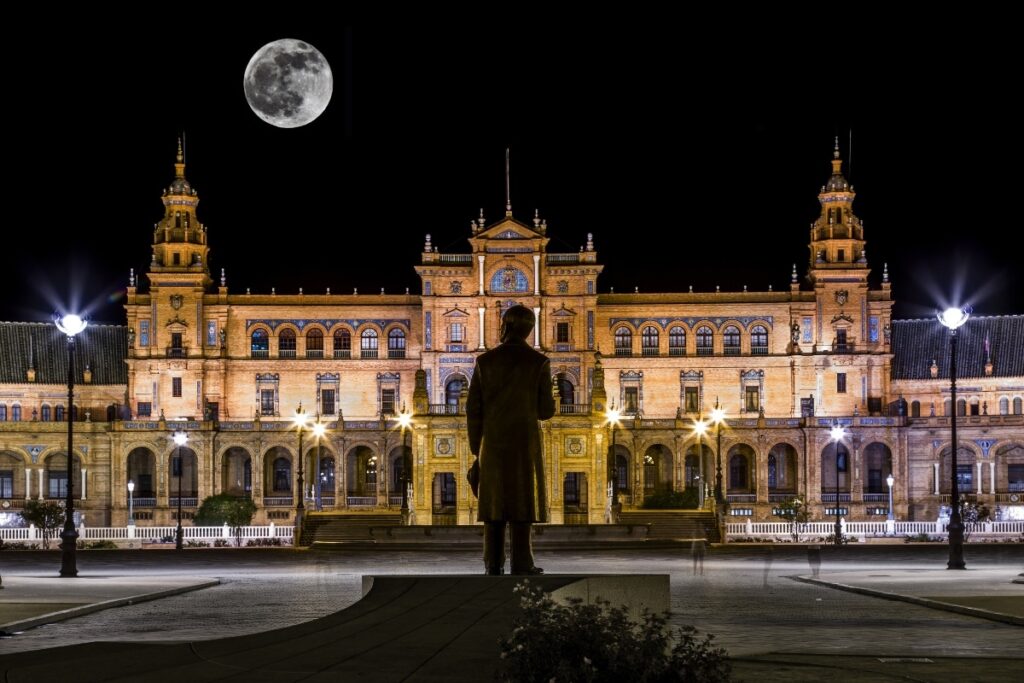
The Plaza de España is an architectural complex located in the María Luisa Park in the city of Seville.
It was designed by the architect Anibal González. It was built between 1914-1929, as one of the main constructions for the Ibero-American Exhibition of 1929. The Plaza de España was the largest pavilion built for the exhibition and the central building of the exhibition. It is the largest building of all those erected in the city during the 20th century, comparable to the other two outstanding historical constructions outside the city walls, which are the 16th century Hospital de las Cinco Llagas and the 18th century Royal Tobacco Factory.
History
The Ibero-American Exposition took place in Seville. It was inaugurated by King Alfonso XVIII on 9 May 1929 and closed on 21 June 1930. It was one of the most relevant and important events in the history of Seville. It was held as a sign of twinning between Spain, Latin America, the United States, Portugal, Brazil and as a gateway to open to new external currents. Seville would be an example of a modern and prepared city. The idea of holding an International Exhibition in Seville was born in 1909, proposed by the artillery commander D. Luis Rodríguez Caso.
Seville was far behind the rest of the cities and countries participating in the exhibition.
The problems of greatest concern were those relating to the expansion of the city, sewerage, paving, water supplies, electricity, housing, and hotels. It took twenty years to bring about such a change.
D. Luis Rodríguez Caso, Aníbal González and Torcuato Luca de Tena, founder of the ABC newspaper. They were key figures in meeting the expectations of such a great event.
In 1911, the architect Anibal González was appointed architect director of the exhibition, who was responsible for the design and construction of the square, on which some of his collaborators also worked, such as the engineer José Luis de Casso and the architect Aurelio Gómez Millan.
In the same year, 1914, after the project was approved, the foundation stone was laid by King Alfonso XIII and work began on the levelling and earthworks.
In the same year, 1914, the opening of the María Luisa Park and the widening of Calle Genova, today’s Avenida de la Constitución and La Campana, took place.
Between 1916 and 1928, construction work began on the Grand Hotel Alfonso XVIII and the Grand Hotel Majestic, today the Hotel Colón. Two historic buildings that are still standing today.
In 1926, after the resignation of Mr. Anibal González as the architect director of the Exhibition, due to continuous budget cuts and problems with the administration, the architect Mr. Pedro Sánchez Núñez took over the completion of the project.
The square was finished in 1928, the architect Vicente Trever y Tomás was the one who finished the enclosures of the enclosure and added the fountain in the centre of the square in 1927.
Description
The Plaza España is 170 meters in diameter and has a semi-elliptical shape, symbolizing Spain’s embrace of its former American territories, and looks towards the Guadalquivir River as the route to follow towards America. Its total surface area is approximately 50,000 square meters, of which 19,000 square meters are built up and the remaining 31,000 square meters are open space.
It is bordered by a canal that runs for 515 meters and is crossed by four bridges. The central body, with two curved side arms and two towers at the north and south ends, is 75 meters high.
In the centre is a larger building, the only one whose volume stands out on the rear façade and which, on the front, is the only three-story building with its superimposed arcades. It is built of exposed brick and decorated with marble, coffered ceilings, wrought iron, balusters, and ceramics. The ceilings of the gallery in the square have wooden coffered ceilings supported by marble columns.
The benches
On the walls of the square there are 48 benches representing, in alphabetical order, forty-six Spanish peninsular provinces, all of which are represented except Seville, and the two archipelagos (the Canary Islands and the Balearic Islands), with their coat of arms, a map and a tile panel of Pisan tiles with important historical facts. The benches are divided into four sections, and at the beginning and end of each section there is a tiled panel relating to the province of Seville. On either side of the benches are two small towers with shelves that are used to hold books. Other noteworthy details are the many reliefs made by the sculptor Pedro Navia
6 Renaissance windows.
The coat of arms of Seville adorning the doors of Aragon and Navarre.
24 imperial eagles with the coat of arms of King Charles I.
48 medallions with the effigies of illustrious personages on each arch comprising each province.
4 heralds, three meters high, representing the ancient kingdoms and flanking the two towers.
The backs of the benches and some of the lampposts are made of wrought iron. The medallions with effigies are of illustrious Spaniards.
The canal
The canal is crossed by four bridges that represent the four ancient kingdoms of Spain. Leon, Castile, Navarre and Aragon.
The Fountain. The fountain is the work of the architect, D. Vicente Trever. This fountain is decorated with sixteen marble markers, the work of Santiago Gasco.
Destination of the square
Initially, after the end of the exhibition, its destiny was to form part of the University of Seville. However, it became the headquarters of the military government, and its rooms were used as the location of the Delegation of the Central Government in Andalusia and at the same time as the Military Museum of Seville. Today it houses the sub-delegation of the Spanish government.
The central part of the building in the square is currently the headquarters of the Captaincy General and the Headquarters of the Land Force.
It has also been the chosen setting for major haute couture clothing firms and film shoots.
The Anibal González roundabout
It is in front of the Plaza de España. It is in the centre of Isabel la Cattolica Avenue.
It was inaugurated on 27 May 2011. The monument is a 2.5-metre-high bronze statue of the architect, on a granite pedestal with a ramp leading down to it. The authors of the monument were the architect Manuel Osuna, and sculptors Manuel Nieto López and Guillermo Plaza.
Biography
D. Anibal González Álvarez-Ossorio was born in Seville on 10th June 1876.
He was an architect and a leading figure in Sevillian regionalist architecture. He was the architect director of the Ibero-American exhibition from 1911 to 1926. Considered the most important Spanish architect of the early years of the 20th century. As the creator of Sevillian regionalism, Mr. Anibal González, was. Creator of ornamental forms, especially prolific on the façades, within his unique style, the architect sought an autochthonous identity of times gone by, in which exposed brick, wrought iron, tile and plasterwork were the basic materials of his construction. Seville also owes to this magnificent architect the scent of orange blossom in our streets.
Although there were already orange trees in Seville since the Muslim period. There were only a few trees in some squares. It was more common to see these fruit trees in private manor houses. It was D. Anibal González, who brought the decoration of the orange tree to the streets.
The architect himself wrote on 11 February 1913 in the article “La casa sevillana” (The Sevillian house) published in the newspaper “El Liberal”.
“It is necessary to revive interest in local things”.
Our constructions should therefore be essentially regionalist, as we have a very rich architectural treasure and countless artistic objects that should serve as a guide and inspiration. In the 1920s, he was president of the Andalusian Association of Architects and vice-president of the Seville Athenaeum. He graduated from the Madrid School of Architecture and was awarded his degree on 25 November 1902. He had the best academic results of his class. Between 1909 and 1920 he focused on historicism and neo-Mudejar architecture. In 1910, he took part in the competition for the design of the Ibero-American Exposition site.
In 1911, he was awarded the post of director of the exhibition works for the Ibero-American Exposition. This was his most significant work in his professional career. On 9 January 1920 he suffered an attack next to his house from which he escaped unharmed, in which he was shot twice without being hit. At that stage, the building industry was on strike and the masons’ councils published a manifesto in which they said that the architects were responsible for the guild’s failure to achieve its objectives.
The press gave the architect unconditional support, and a large demonstration was organised in front of his house. On 4 March it became known that the attack had been carried out by four anarchists from the bricklayers’ union. In September 1920, he was awarded the Grand Cross of the Royal Order of Isabella the Catholic and on 17 February 1922, he was decorated with the Grand Cross of the Civil Order of Alfonso XII. In February 1929, he was also named Favorite Son of Seville.
The Count of Colombí was a member of the Executive Committee of the Exhibition from the beginning and was appointed Royal Commissioner but resigned in December 1925 due to disagreements with the administrators of the competition. He was succeeded by Mr. José Cruz Conde, who thought that the pace of construction that the architect Mr. Anibal González was carrying out in the Plaza de España was too slow, and he also reduced the budget. As a result, some of the architect’s works were never carried out. The architect D. Anibal González disagreed with Cruz-Conde in several aspects and resigned in 1926. He was replaced by the architect Vicente Trever who, in addition to some small works, built the casino and the theatre of the exhibition site, which is now the Lope de Vega Theatre.
D. Anibal González died at the age of 53. His funeral was attended by a large crowd, including people from the construction sector. At the time of his death, he was poor and had accumulated several unpaid bills as he had not been paid for most of his work, in which he invested most of his time. Because of this, the architect accumulated unpaid bills. This was compounded by a serious intestinal illness, which meant that he was unable to continue working. Only twenty-two days after the opening of the exhibition, he died of his illness. The newspaper “El Liberal” proposed a collection for his family. Various citizens and organizations of the city donated money. On 20th October 1929, the total amount of donations in cash and building materials was 150,000 pesetas.
Between 1930-1932, a new house for the widow and her children was built on a plot of land belonging to the Marquis of Esquivel. The design and direction of the works was the responsibility of the architects, Juan Talavera, and José Espiau. This house is in the regionalist style and is located at number 14 Avenida de la Palmera. The city had not paid any homage to him, so in the year 2000, the Town Hall decided to place a monument in front of his greatest architectural work.
Thank you, Mr. Anibal, for your great contribution to our city. Seville will always be indebted to your great work.

¿Did you like this post?
Share it in: