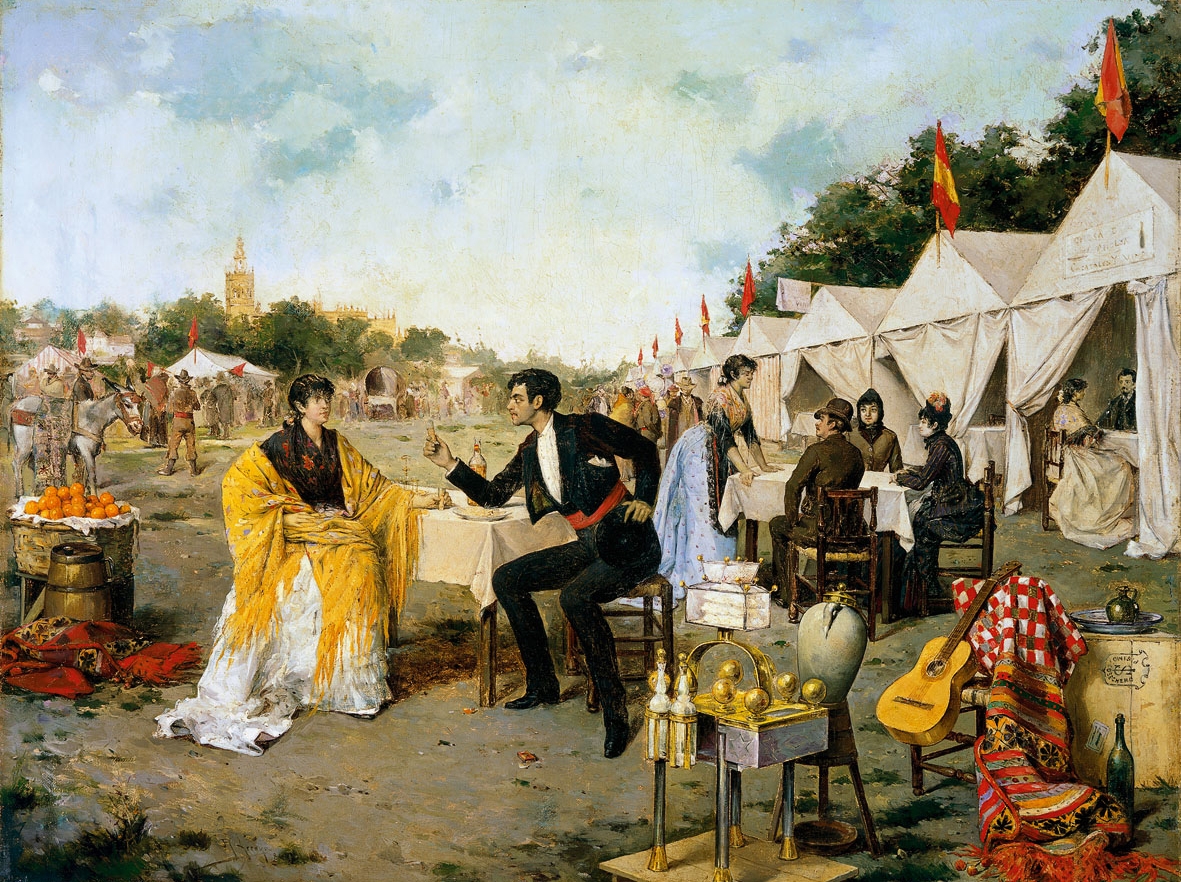
The April Fair or Seville Fair is held annually in the area known as the Real de la Feria. It is a spring festival that has its origins in the foundation of the Royal Isabella II. She authorised a decree for its authorisation.
Its origin dates to 1847, when two councillors, Spanish businessmen and livestock farmers settled in the city of Seville, asked the city council to hold an agricultural and livestock fair.
It was inaugurated on 18 April 1847, in the meadow of San Sebastián. With 19 booths for the sale of livestock. What began as a commercial event, over the years was extended with permits and licenses for taverns and snack kiosks, until it became what it is today, an event known practically all over the world. We Sevillians have made it our own. Its assembly begins in October of the previous year each year. It lasts seven days, with the most popular day being the day of the “pescaíto”, which usually takes place in the early hours of Saturday to Sunday, when it is customary to serve fried fish, accompanied by the official drink “fino de Jerez or manzanilla”.
This is the day on which the Fair officially begins at 00:00 at night, a spectacle of lights and joy.
It should be noted that the entrance to most of the “casetas” is private and exclusively for members, you can only enter if you are invited by a member, there are public “casetas”, although unfortunately they are not recommended due to their neglect and increasing vandalism.
Traditional costume
The traditional costume is a typical Andalusian costume, it comes from the typical costume of the Andalusian Maja. It has been associated with Andalusian costumes since the end of the 13th century. It is commonly called gypsy costume or flamenco costume.
Nowadays it is traditionally worn at the fairs, pilgrimages, and May crosses.
Shawls and shawls
The shawl is a work of art, a silk canvas decorated with flowers and bright colours, with fringes around the edge. This piece was usually worn by the most prominent women of the time in the Andalusian capital. It was immortalized by painters such as Joaquín Sorolla and Julio Romero de Torres.
The origin of this accessory is still unclear, but its name comes from manila “Filipinas”, the former Spanish territory. Origin of the maritime trade routes during the Spanish imperial period.
THE DANCE “Las Sevillanas”.
It is a dance originating from Seville and comes from the contact of the seguidilla castellanomanchega with the soleá, the fandangos and other styles and is accompanied by clapping and castanets.
Horseback riding and horse-drawn carriage
The carriage is the vehicle of transport allowed in the Real de la Feria, except for official carriages and emergency vehicles.
The carriages “horse-drawn carriages” are dressed in their corresponding gala attire and the coachmen are dressed in short suits and wide-brimmed hats.
The horses are dressed in their tassels, bells and bells and always make their route during the day along a set route through several blocks of the Real.
Another big day for them is the day of the “Enganches”, a day when they go to the bullring of the “Maestranza de caballeria”, a big day, where you can enjoy an exhibition of carriages of great artistic value, where carriages of all times are exhibited, authentic jewels of the Andalusian aristocracy and bourgeoisie, organised by the Real club de Enganches de Andalucía (Royal Carriage Club of Andalusia).
The Bullfighting
The bullfighting shows have been part of this celebration from the very beginning. Nowadays, starting on Easter Sunday, two weeks before the fair, the bullfighting season begins in the bullring of the Real Maestranza de Caballería. The so-called “announcement” posters of the biggest names in bullfighting.
The fair is a festival of light and colour where the people of Seville turn out every year dressed in their best attire.
Image Painting ‘LA FERIA DE SEVILLA’, 1867, BY JOAQUÍN DOMÍNGUEZ BÉCQUER