There are three reasons why this neighbourhood is believed to have been christened Triana. Well, some think that its origin is the evolution of “Triana”, the name it would have received because the Roman settlement was founded by the emperor Trajan. Another version maintains that it is the result of the union between “Tri” (Latin for “three”) and “Ana” (Celtiberian for “river”). Finally, there are those who consider Triana to be the evolution of “Transanmen”, meaning “beyond the river” due to the location of this neighbourhood, which is on the other bank of the Guadalquivir river.
Triana began to take shape in the second half of the 12th century, when Abu Yakub Yusuf decided in 1171 to build a bridge of boats made up of several boats linked together by iron chains, leaving space between them for the water to circulate.
This led to the union between the two banks of the river, which is when Triana began to be treated as a neighbourhood. This bridge was replaced by the current bridge, the Isabel II Bridge, or as it is called, “El Puente de Triana”.
It was built between 1845 and 1852 by the French engineers Gustave Steinacher and Ferdinand Bennetot, inspired by the Parisian Carrousel Bridge. This bridge had been built in 1834. The Isabel I Bridge allows us to enter Triana, reaching first of all the Plaza del Altozano, the centre of reference of the neighbourhood, historically it was the point where travellers from the nearby towns of Seville would accumulate to cross to Seville.
At the foot of this place we find the remains of the old Castle of San Jorge, this fortress was created by the Visigoths to defend the bridge of boats, but later became the headquarters of the Inquisition in 1481. In 1823, the Triana Market was installed on the site of the castle, as mentioned above. This has remained in operation until the present day. In 2009 the City Council of Seville inaugurated the project of the Castle of San Jorge, thus creating a centre for the interpretation of the ruins and the religious repression of the Spanish Inquisition.
Next to the bridge is the Chapel of Carmen, designed by the architect D. Aníbal González and built in 1929. As it is located at the entrance to the neighbourhood, this chapel is a place of prayer for those entering and leaving Triana. Nowadays there are people who maintain the tradition and sometimes you can see how they cross themselves as they pass by.
Another place where the Plaza del Altozano takes us is Calle de San Jorge, where we find the ceramic museum, the former Santa Ana ceramic factory, which was founded in 1870. This neighbourhood was the initiation area for the first potters, who began to make clay pots until they ended up creating their own style, going beyond the boundaries of the domestic and turning it into decorative art and a new form of expression. This united the three guilds, potters, potters and ceramists, creating a single guild. From the 15th century onwards, painting was introduced into the tiles, creating art in them, and in the 20th century, with the rise of the brotherhoods of Seville, the elaboration and placement of fascinating ceramic altarpieces in all corners of Seville was encouraged, in which the images of the images of the Sevillian brotherhoods were painted.
Not only are the tiles used for the images, Seville is full of hand-painted tiles with characteristic coloured patterns and shapes, which decorate parks, façades and patios. Moreover, this type of art is so closely related to the city that even the names of the streets are written in tiles.
Calle Castilla was the starting point where the Muslim suburb originated, and it was here that the Triana neighbourhood expanded. In the 13th century, this initial section of the street was lined on both sides with vegetable gardens, as well as the dwellings of the market gardeners, which later became the Royal Soap Factory of Muslim origin. Along the street you will come across the church of Nuestra Señora de la O, home to the brotherhood of Nuestra Señora de la O, a temple that was built in 1702. In the early hours of Good Friday morning, 9th April 1830, the Brotherhood of Nuestra Señora de la O made its penitential procession to the Cathedral of Seville, being the first brotherhood of Triana to cross the Guadalquivir River, using the old Puente de Barcas (Bridge of Boats).
Its images are Jesús Nazareno, which was carved by Pedro Roldán in 1685, but which after the civil war had to be recomposed by Castillo Lastrucci in 1937 and later restored in 1993. María Santísima de la O is the second image of this brotherhood and was destroyed during the Civil War, which meant that it had to be replaced by Castillo Lastrucci in 1937.
In front of the Triana Bridge begins the pedestrian street of San Jacinto, which was the old communication route to the Aljarafe. In this street is the Church of San Jacinto, designed by Matías de Figueroa, which belongs to the old convent of San Jacinto, built in 1676 for the Dominican Order. It is worth mentioning that this was the site of Seville’s first fighter plane factory, the prestigious ceramic factory of Manuel Ramos Rejano and the Red Cross Dispensary.
Nearby we find Pureza Street, where we find the church of Santa Ana, whose construction began in 1266. It is in Gothic-Mudejar style and is the oldest church in Seville. It was founded by King Alfonso X, the reason why the King ordered it to be built, according to the inscription on one of its walls, was to cure the monarch of a disease he suffered from in his eyes, through the miraculous intervention of Santa Ana. This church is so important in Triana that it is known as the “Cathedral of Triana”. On the same street is the Chapel of the Mariners, built in the 20th century and currently the headquarters of the Hermandad de la Esperanza de Triana (Brotherhood of the Hope of Triana). The Virgin is one of the most famous in the city and is popularly known as the Queen of Triana or the Trianera. The images of this Brotherhood are the Santísimo de las Tres Caídas, attributed to Marcos Cabrera between 1608 and 1630, although it has been restored on several occasions by different sculptors who have made major changes such as replacing the natural hair with one made of paste or the creation of a new body.
Another of the most famous streets in this neighbourhood is Calle Betis, a name that refers to the Latin name of the Guadalquivir River. The street is home to the Casa de la Columnas, a building created in 1780 on the site of the former Universidad de Mareantes, The building occupies two floors and is structured around two courtyards. It has two façades, a main neoclassical façade with large Tuscan columns, facing Calle Pureza, and a secondary façade facing Calle Betis. For a time it was used as a residents’ courtyard, but nowadays it belongs to the Town Hall, which has turned this building into a municipal civic centre “Centro Civico Las Columnas”.
CORRALES AND COURTYARDS OF NEIGHBOURS IN TRIANA
In Triana there are also several typical Sevillian houses, called corrales de vecinos. Nowadays, very few of these houses are preserved, but we still have the privilege of being able to contemplate them.
CUSTOMS AND TRADITIONS OF THE TRIANA QUARTER
Cavalcades of the Three Wise Men.
This tradition began in Seville in 1918 and nowadays consists of a parade of floats with children dressed as cartoon characters and children’s stories who hand out sweets, sweets and toys through the streets to children and adults. They are also accompanied by music bands and Bedouins who entertain, dance, sing and hand out sweets and sweets on the streets. These floats travel all over Seville, passing through the Triana neighbourhood, and this neighbourhood also has its own floats that parade the day after the Seville floats.
Velá de Santa Ana.
The Velá de Triana in honour of Santa Ana is the oldest festival in Seville. It originated in the 13th century when the neighbours of Triana and Seville, who came to the church to watch over the virgin during the night, on the eve of 26th July. Although at the beginning it was of a religious nature
Over the years it became more popular, accompanied by dancing and singing at the doors of some houses.
The “velá” was lived in and around the church and, above all, by the river. In fact, for centuries, the Guadalquivir was the stage where the main activities of the velá took place. Later on, between 15 and 20 stalls were set up around Betis street and shows in the Plaza del Altozano and the so-called “cucaña” in which the youngsters have to challenge a slippery wooden pole to reach the flag at the end of it.
at the end of it.
HISTORICAL FIGURES FROM TRIANA
Saint Justa and Saint Rufina
Saint Justa and Saint Rufina were two sisters who were born in the 3rd century, in the years 268 and 270 respectively, in the district of Triana. These sisters were dedicated to pottery and were also very generous, and when their neighbours needed help they turned to them. At that time the city was under Roman rule and the sisters belonged to the religion of Christianity, so on the day of the feast of Venus, the sisters refused to contribute to the celebration, the spectators at the gates of their house entered and broke their pots, the sisters in response to this act broke the statue of Venus. For this, the sisters were imprisoned and tortured to death. Bishop Sabinus collected the bodies of both sisters and gave them a Christian burial. The veneration for these sisters was so great among Christians that they were named patron saints of Seville and of potters and potters’ workshops. Their liturgical feast is celebrated in the Cathedral every July 17th.
Rodrigo de Triana
Juan Rodríguez Bermejo, baptised Rodrigo de Triana, born in 1469, was a Spanish sailor at the end of the 15th century, a Spanish sailor who accompanied Christopher Columbus on his first voyage of discovery of the Americas. According to historiography, he was the lookout who warned of the new world by shouting “land! This illustrious sailor has a statue dedicated to him in Calle Pagés del Corro, Triana.
Juan Belmonte
Juan Belmonte García, born in Calle Feria in 1892, although he moved to the Triana neighbourhood at an early age, so he considered himself a “trianero” (from Triana). He was the most popular bullfighter in history, revolutionising bullfighting by putting into practice the three forms of bullfighting: parrying, tempering and commanding. He was also a peculiar bullfighter as he was an inveterate reader, so his intelligence and magnificent personality allowed him to interact with members of high society and culture. No bullfighter had ever achieved this before, and practically no one ever did afterwards. He was christened the “Pasmo de Triana”, because of the impression made by Belmonte, as mentioned above, and “de Triana” because he was from Triana.
HISTORY OF TRIANA FLAMENCO AND ITS ARTISTS
This Spanish musical genre dates back to the 18th century, there are controversies about the origin of this genre since its origin cannot be historically proven, although after years of history it is said that it originated in Andalusia due to the notable presence of the gypsy people in the different provinces of southern Spain. In 2010 flamenco was proclaimed Intangible Cultural Heritage of Humanity by UNESCO.
Triana is considered to be the cradle of flamenco, as great artists and masters of flamenco have been born and continue to be born in this neighbourhood. It also has its own singing and dancing known as “Soleá de Triana”.
Flamenco was born from small gatherings between friends and family, becoming a public character through its performance in theatres and other places. Nowadays in this neighbourhood of Triana there are innumerable places where you can enjoy this art form, and Calle Betis is where you can find the most flamenco shows.
Next, we will explain the origin of the greatest Triana artists
Lole Montoya
Dolores Montoya Rodríguez was born in Triana in 1954, member of a gypsy family, being the daughter of Antonia, nicknamed “La Negra”, dancer and singer very well known because she also sings in Arabic, and Juan Montoya.
In addition to being a singer, she was also a professional flamenco dancer, taking part in flamenco tablaos.
Later, she formed a duo with Manuel Molina, who was her husband for years, and had a daughter, Alba Molina, also a singer. This couple recorded numerous albums for more than twenty years. They were very well known due to their new flamenco creation, being a reference couple in the world of flamenco.
In 1989 Lole was already performing solo and was invited by the King of Morocco Hassan II to give a recital accompanied by an orchestra.
Lole is a reference and teacher of great flamenco artists, not only for her magnificent singing, but also for the freedom and strength she transmits.
Juan Pelao
Juan García Moreno was born in 1856 in the Triana neighbourhood, both he and his family were blacksmiths. When he was orphaned at the early age of 14, it could have been a good decision for him to dedicate himself to flamenco singing and dancing, but he always defended that taking money through singing and dancing was something terrible, he considered that in this way he sold himself to the spectators who saw him.
Juan Pelao was important in the world of cante de fragua, he was considered the best martinete of the time because he, as a blacksmith, knew the sound of metal against metal, a sound that sometimes accompanies the singing of the martinete.
There is no record of this great artist singing outside of Triana, and even less in local venues. The cantaores trianeros sang only at family parties or in the taverns of the neighbourhood to relieve their sorrows or talk about their lives.
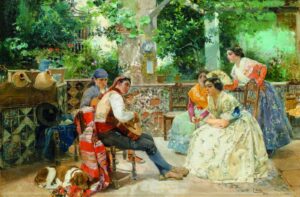
Image Painting: Bullfighter, gypsy and canes of manzanilla in ‘On the banks of the Guadalquivir’, by Gonzalo Bilbao.

¿Did you like this post?
Share it in: