Spain with port, located some 90 kilometres from the Guadalquivir River. Navigable from its mouth at Sanlúcar de Barrameda.
Seville has an old town of 3.9 square kilometres.
It is the largest old town in Spain and the sixth largest in Europe. With three monuments declared World Heritage Sites by UNESCO in 1987. A city full of humanists and intellectuals since its origins.
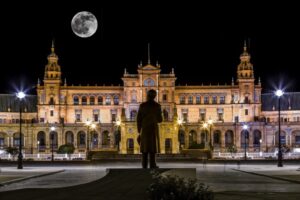
Its historical and monumental heritage and its many cultural and scenic areas make it an ideal city for national and international cultural tourism.
It is one of the cities with the most catalogued monuments in Europe and the third city in Spain with the highest number of visitors.
Our origins: There are several versions about the origins of Seville. We have opted for the version that we believe is more in line with the reality of the remains that have been found.
The city was founded in the 8th century BC by the Tartessians, followed by the Greeks, Phoenicians, Carthaginians, Romans and Muslims.
From the Tartessian people, archaeological remains were found, dating back to the 8th century BC, known as the treasure of “El Carambolo”.
This treasure contains pieces of solid gold.
The cause of the disappearance of this people is not known.
After them came different cultures: Turdetan, Iberian and Punic. After defeating the Carthaginians who dominated the city around 206 BC, the Romans arrived and named the city “Híspalis”, building a residential colony on the outskirts of the Roman aristocracy, which was in the area we know today as Plaza de la Alfalfa, Plaza de El Salvador, and Cuesta del Rosario.
Italica was a Roman residential city and the birthplace of two Roman emperors, Trajan, and Hadrian. These remains can be visited in the nearby village of Santi Ponce.
In 246 Seville had several invasions, being conquered by the Visigoths, in which Leovigild and his son Recaredo reigned as great kings. This period was apparently a bad time for Seville, but thanks to the figure of San Isidoro, who was born in the city in the year 560, and who wrote “The Etymologies”, the encyclopaedia of knowledge of the time, which made the city stand out as a cultural centre and attracted great intellectuals of the time.
The image of San Isidoro is one of the figures that appear on the coat of arms of Seville. According to tradition, this is when the first Jews arrived in Seville after the destruction of the first temple in Jerusalem by Nebuchadnezzar in 587 BC. The Muslim era would arrive in 712 a.c, conquered by Muza and lasting five centuries.
The Muslims renamed the city Isbiliya, from which Seville derives its present name.
Seville became the most important city of the Taifa kingdom, being the focus of culture and wealth, governed by King Almutamid, known as “the poet”. After the Taifas came the Almoravids and Almohads.
The Ababdid dynasty was the first kingdom of Seville, the kings of Al-Andalus, who left the city the historical heritage that we still preserve in the old town.
The Giralda, Torre del Oro and the Alcázar, Seville’s most emblematic monuments, date from this period. And this year, the thousand years of the kingdom of Seville are being commemorated.
Christian era the reconquest of the city of Seville took place between 1247 and 1248 by King Ferdinand III of Castile “The Saint”, where he remained until his death.
He would be succeeded by his son Alfonso X “The Wise”, a period in which the kingdom of Seville reached its greatest extension.
During the period after the reconquest, Seville had a large Jewish population, which was finally expelled in 1492. From the Jewish legacy we still have the Jewish quarter, which is made up of the districts of Santa Cruz, Santa María la Blanca and San Bartolomé.
It was during this time that King Charles I chose Seville as his habitual residence and from where he planned the end of the reconquest, which came to an end in 1492, when the kingdom of Granada was finally handed over to the Catholic Monarchs.
The Catholic kings
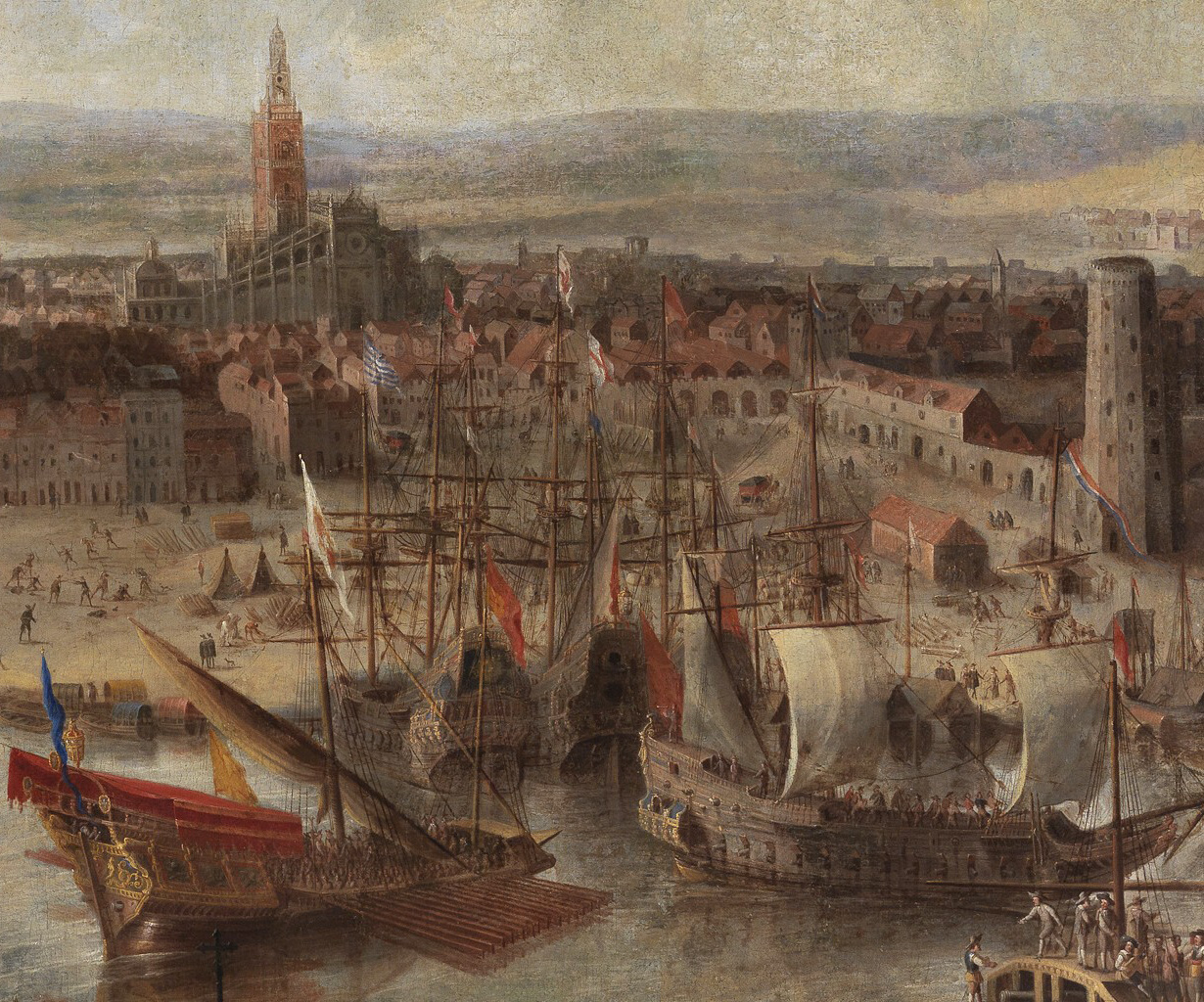
After the discovery of America in 1492, Christopher Columbus arrived at the docks of Seville announcing his great exploit and from where the different fleets that would continue with the conquest of new lands were organized.
In the 16th century, Seville was the main port of trade with England, Italy and Flanders, where the monopoly of the link with America was established, founding the current Casa de la Contractacion (Archivo de Indias).
Seville experienced significant demographic and economic
and economic growth, which made it the largest city in Spain. Seville became the city of merchants with people of all nationalities and great fortunes.
Religion
In the religious sphere in Seville, the most important figures are exclusively members of the Christian faith, a religion that still exists today.
Seville, like all other Spanish cities, is eminently Catholic. According to its historical origin, the city dates to the 3rd century, when it was under Roman rule. The patron saints of Seville, two sisters born in Híspalis (Seville) under the Roman Empire in the year 268 and 270 called Justa and Rufina, from a modest family of clandestine Christians, dedicated to the pottery trade where they lived and had their stall of handmade pieces, had a lot to do with this. For this reason, we can see these sisters so represented in the guilds of potters and potters.
After the Roman period, in the 5th century, the city was taken by the Visigoths, at which time two other brothers called San Leandro and San Isidoro appeared, they were of Carthaginian origin, but both brothers professed Catholicism, and both clerics were canonised.
Another Saint from Seville was Saint Angela of the Cross, who was born and died in Seville, and to whom a miracle of healing is attributed. Sister Angela of the Cross founded a religious congregation to help the poor and sick, actions to which she dedicated her life. Marcelo Spinola, Archbishop of Seville, was also beatified.
Motto of our city

The motto of the city is present on a multitude of buildings,” NO8DO” where the eight represents the shape of a skein of wool. In the Sevillian tradition we read it as “NO madeja DO” which means “he has not left me”. This is a tradition with no documentary basis, which has its origin in Argote de Molina (1588). The motto is interpreted as a reference to the city’s loyalty to King Alfonso X “The Wise”.
Our traditional dances
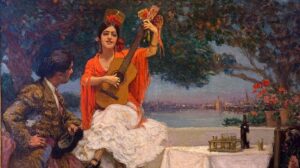
Traditional dance, sevillanas and flamenco.
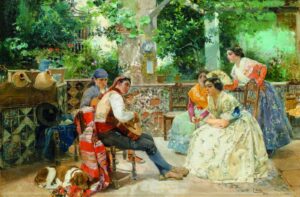
Sevillanas is the typical dance of the city of Seville and is widely performed at fairs and celebrations throughout Andalusia.
They are seguidillas that have been transformed, although they keep their interpretation in four coplas, almost exclusively for dancing.
Flamenco is also a very important part of Andalusia, it is much more than an artistic manifestation, it is a profound expression of feelings, emotions and moods through voice, dance, and musical accompaniment. For the performance of this Arte Mayor, the artists dress in typical traditional costumes of the region. Seville, throughout the year is an open stage dedicated to flamenco, festivals, events, and activities that take place related to this Andalusian art. One of the best known is the Bienal de Flamenco de Sevilla, which is held every two years. In 2010, UNESCO declared flamenco as intangible heritage of humanity because of its uniqueness.
Andalusia is the cradle of flamenco and Seville has seen the birth of great flamenco artists, and you can visit some statues, tiles and toponymies that refer to some of these great singers, although many are missing.
Our popular festivals:
Semana Santa, spring festival and pilgrimages, and bullfighting, are the most emblematic festivities in Seville. These festivities are celebrated during the first months of the year and are eagerly awaited by many Sevillians.
Coat of Arms of Seville
“Since that time, Seville has had as its seal and arms the Holy King Don Fernando in Tribunal Assentado, with a naked sword, raised in the right hand and in the left a globe of the world, between the two glorious brothers Leandro and Isidro, patrons of Seville, and their prelates”.
Flag of Andalusia

Andalusian Dialect
Andalusia, an autonomous community in the south of Spain, where most of the year the sun shines and there is plenty of light for many hours a day, so the people of Andalusia spend more time in the street.
It is very common and customary in Andalusia to meet in the street with family and friends, so people talk more in groups, and this makes it more difficult to communicate, so they raise their voices and speak faster. In Seville an Andalusian dialect is spoken, the main characteristics of which are the seseo, but this is not always the case. Among the most outstanding characteristics of our phonetics, it is lost in groupings such as institute which would be Is/ti/tu/to, said by a Sevillian.
In general, there is little articulatory tension, which leads to relaxation and aspiration of some phonemes or even their loss. The [S] is aspirated after/despu/e/, pescado/pesca/o and the final [d] and [r] are lost: maldad/mar/da/, caminar, cami/na/. It should be noted that the dialect is only spoken and not written. The writing does not vary, it is written in Spanish.
Another very common characteristic is the word “miarma” which is used to refer affectionately to someone.
Image painting: “View of Seville” Anonymous 17th century Flemish painter.